Ukraine War Update: 3 Killed, Stunning Moscow Drone Strike


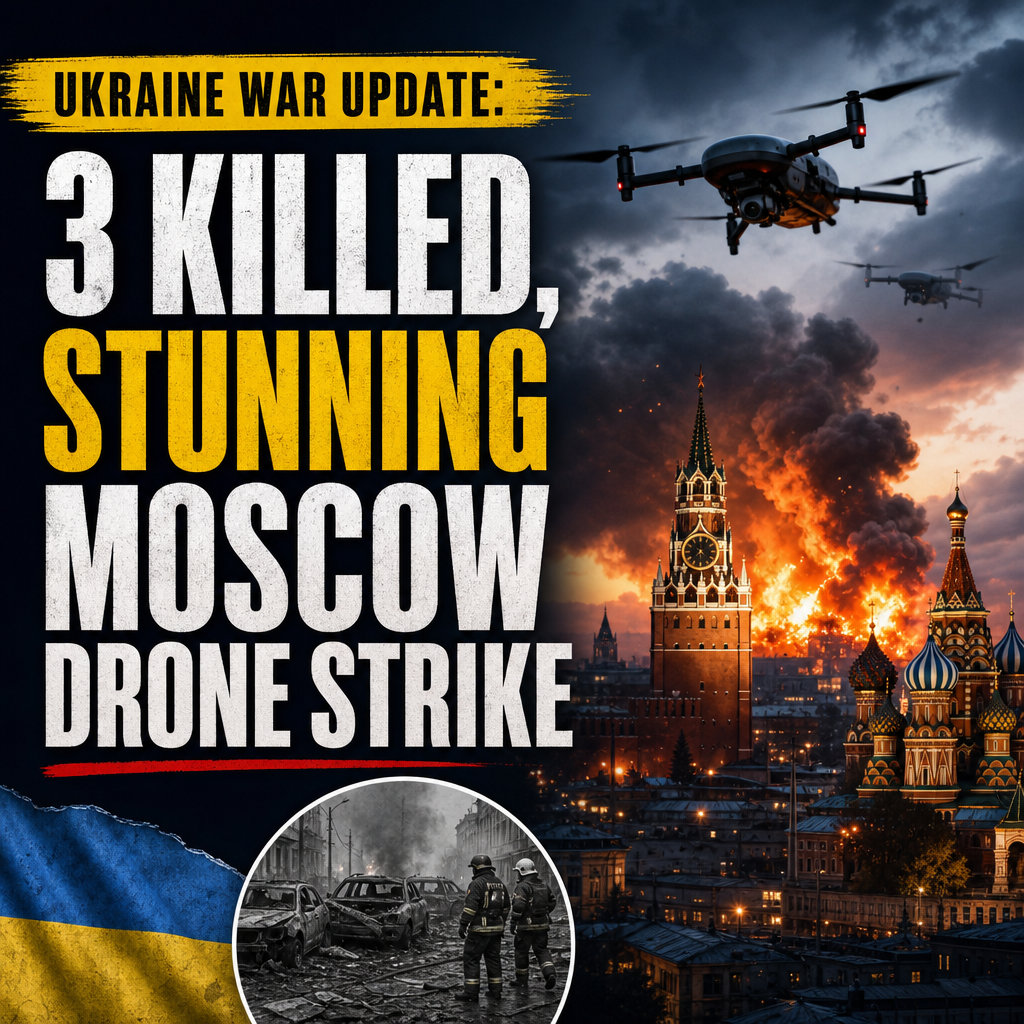
Ukraine War Update: the latest flare-up between Kyiv and Moscow has again shown how quickly this war spills beyond the battlefield, with a reported drone strike on the Russian capital coming just as Ukraine says three people were killed in fresh attacks on its territory.
The timing matters. The Moscow strike has been framed by Russian outlets and state officials as proof that Ukraine is capable of reaching deep inside Russia, while Ukrainian-leaning coverage and international reporting have placed it inside a broader pattern of drone warfare, retaliatory strikes, and escalating pressure on civilians on both sides. What is clear from the reporting across Al Jazeera, Sky News, and RT is that this is not an isolated incident. It is part of a worsening cycle in which each side presents the other as the aggressor and uses the latest attack to reinforce its own narrative.



Ukraine War Update: what the latest strikes tell us
The Moscow drone attack drew the most attention because of where it landed. A strike near or within the Russian capital carries symbolic weight well beyond the physical damage it causes. Even when casualties are limited, the psychological impact is outsized. For Russian authorities, this kind of attack is especially sensitive because Moscow is supposed to be far from the front line. For Ukraine, or anyone supportive of its war effort, such strikes can be interpreted as a sign that Russian air defenses are being tested and that the war is no longer something Moscow can keep at arm’s length.
At the same time, the reports also underscore the heavy toll Ukraine continues to bear. Al Jazeera reported three people killed in Ukraine after renewed attacks, including the day after a child was killed in Moscow. That juxtaposition is striking: one side celebrates or condemns the ability to hit the other’s capital, while the other side continues to absorb deadly strikes in towns and cities far from any conventional front.




Sky News’ international framing tends to emphasize the broader war dynamics rather than one side’s political messaging. That perspective is important here because it reminds readers that a dramatic strike on Moscow does not make the conflict symmetrical. Russia remains the much larger military power and continues to conduct repeated strikes on Ukrainian territory. The fact that Ukraine can now strike inside Russia does not erase the imbalance in scale, resources, or daily civilian risk.
The different lenses of Al Jazeera, RT, and Sky News
The three outlets point to the same basic event but invite different interpretations.
– Al Jazeera places the attack in a wider human-cost narrative, linking the Moscow strike with the killing of civilians in Ukraine and showing how quickly the news cycle can swing between victimhood and retaliation.
– RT predictably centers Russian security concerns and the vulnerability of Moscow, framing the drone strike as a shocking breach and, likely, as evidence of escalation by Kyiv.
– Sky News tends to situate such incidents within the strategic and diplomatic picture, asking what the attack means for the war, for air defenses, and for the prospect of negotiation.
Taken together, these viewpoints reveal a useful truth: in a war this entrenched, facts are only the beginning. Interpretation is the real battleground. Each side chooses the angle that best supports its political needs. Russia wants to show that Ukraine is dangerous and reckless. Ukraine wants to show it is not powerless. Independent international coverage, meanwhile, is left to separate strategic significance from propaganda.
A strike on Moscow does not change the war’s moral arithmetic
There is a temptation to treat a drone hit on Moscow as a game-changing reversal. It is dramatic, yes, but it does not fundamentally alter the moral or military arithmetic of the conflict. The war still appears to be defined by attrition, civilian suffering, and a steady expansion of what once seemed off-limits.
That matters because attacks on capitals tend to generate more headlines than attacks on ordinary towns, even though the latter may be far more destructive over time. In that sense, the latest reporting risks reinforcing a distorted hierarchy of suffering. A child killed in Moscow is newsworthy and tragic. So are the three people killed in Ukraine. The difference is not the value of the lives lost, but the geopolitical attention each event commands.
What the reporting suggests, though cautiously, is that neither side seems close to breaking the cycle. Instead, the war is becoming more technologically dispersed and emotionally charged. Drones allow smaller actors to reach deeper targets, which raises the perceived stakes and increases the likelihood of retaliation. That makes de-escalation harder, not easier.
What to watch next
Several questions now matter more than the headline itself:
– Will Russia respond with heavier strikes on Ukrainian cities or infrastructure?
– Will Ukraine use the Moscow incident to argue for even more air-defense support from allies?
– Do either side’s claims about the strike match independently verifiable damage assessments?
– Could this incident influence any diplomatic signaling, or does it simply harden positions further?
For now, the most responsible reading is also the least dramatic: the strike on Moscow is significant, but it is significant mainly because it reflects a war that is spreading in reach, not in resolution. The civilian deaths reported in Ukraine the following day are a reminder that even when the spotlight shifts to the Russian capital, the center of gravity remains where it has long been — in a country still enduring the daily human cost of invasion.
In other words, the latest events are less a turning point than a warning. This war is still widening its impact, still rewarding spectacle over stability, and still leaving civilians to pay the highest price.